BCM241 – BETA
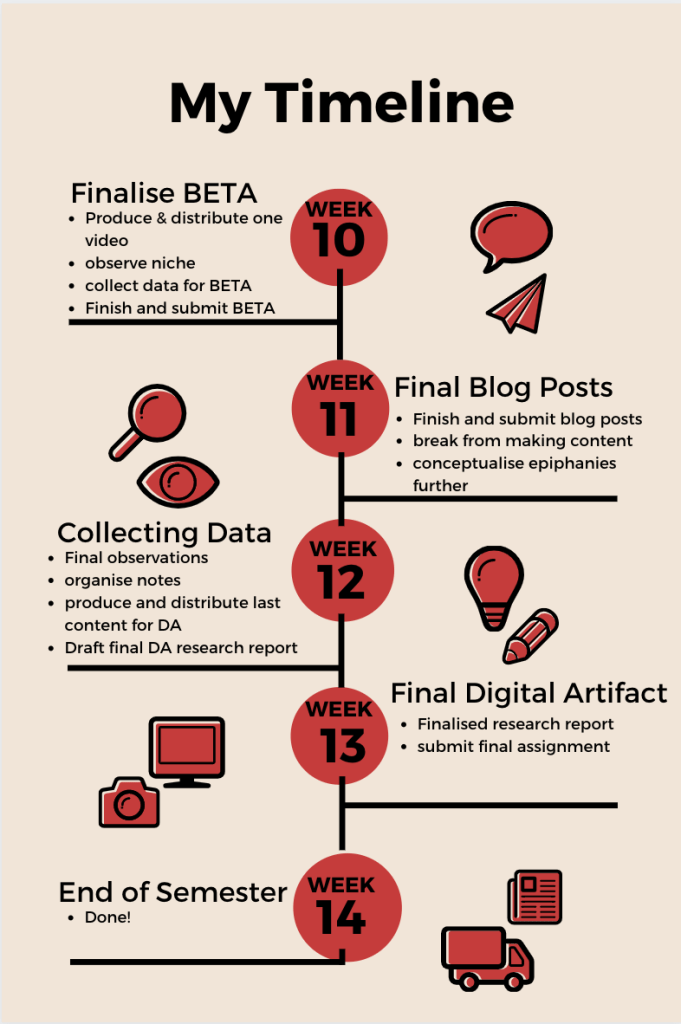
During my autoethnographic research of observing and participating in my media niche, I’ve had some epiphanies and gained knowledge that has led to several iterations in the production of my Digital Artifact. I’ve changed my persona to adhere to the appropriate language/tone for the desired platform (as discussed in my video above). I’ve increased my efficiency in making content by editing footage not shot on my old camera on my phone editing app, figured out export and sequence settings. I also have established a strong aesthetic and maintained it through audio and image to create a cohesive grid of my work on both platforms like other creators in my niche. In my observations and “personal experience” of my niche, I’ve discovered a “facet of cultural experience” that I refer to as a sense of escapism when participating in the content on TikTok (Ellis et al. 2011, p.276).

Upon recognising and observing this experience, I’ve been able to (in my opinion) create content without directly copying other people in the niche, by utilising and developing my unique style and perspective of the content. Escapism in this niche is primarily why I and the collective enjoy it, as an outlet for relaxation, appreciation and creativity (discussed more in-depth in blog post 4). So far I’ve found how out how this media niche operates within the two distinct media outlets (Instagram and TikTok), moving forward with my research I aim to discover how to improve upon my content and boost my engagement through further participation and observation.
Thank you! 🙂 Keep up to date by following @rugratbrain!
Reference List
Carolyn Ellis, Tony E Adams & Arthur P Bochner 2011, ‘Autoethnography: An Overview’, Forum, qualitative social research, vol. 12, no. 1.
Manovich, L 2019, The aesthetic society: Instagram as a life form, Data Publics, Routledge, forthcoming.
Moore, C, Barbour, K & Lee, K 2017, ‘Five dimensions of online persona’, Persona Studies, vol. 3, no. 1, pp. 1–11.
Schellewald, A 2021, ‘Communicative Forms on TikTok: Perspectives From Digital Ethnography’, International journal of communication, p. 1437–1456.


 Hallie Rutter
Leave a comment