
The media theory toolbox blog
My public sphere occurs over a few drinks with my friends where debate of social and political issues happens fluidly between us. Critical theorist, Jurgen Habermas (1962) relates the public sphere as like a 18th century coffee house, which is similar to mine but with coffee instead of tequila (Bruns & Highfield, 2016). Imagined, the public sphere is ideally an all-inclusive physical or virtual space for people to debate and discuss issues of public interest. However, inclusivity is often an ideal that is not often met. Within my friend group, our discussions exclude other age groups, strangers and bluntly those who lean politically to the right. While our sources are usually from who we follow on social media or our trusted news sources.
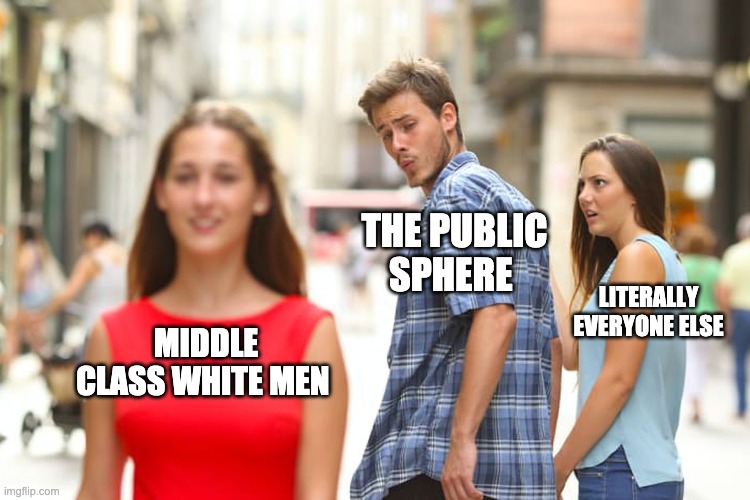
Historically the public sphere has included primarily bourgeois white men and excluded women and minority groups. However, the rise of the internet, has allowed many people access to social media platforms in order to participate in discussions within the public sphere. Making a social media account is cheap and easy, anyone with a device connected to the internet can have a Twitter account and share their opinions despite their race or orientation.
Twitter specifically, has become a huge platform for public debate on social and political issues, referred to as the Twittersphere. In 2008 social media theorist, Clay Shirky, argued that the rise of social media is “…dramatically improving our ability to share, co-operate, and act together” (Fuchs, 2013, p. 185). However, the internet’s public sphere is highly mediated, the media provokes debate in the Twittersphere and the opinions that gain the most attention are stratified by those who have the largest followings and what hashtags are trending (Fuchs, 2013, p. 192). Thus, restricting the inclusivity of the public sphere, though Twitter may provide people with a platform to express their opinions, that does not necessarily mean their opinions will be seen or acknowledged.
What is acknowledged in the public sphere on twitter depends on what’s trending, which is propelled by retweets, replies and likes. Common everyday twitter users with a small number of followers have limited influence over what is trending and are therefore excluded from the larger arena of the Twittersphere. It would be hard for myself, with eight followers, to get any hashtag to trend worldwide, however for someone like Barack Obama, with 115 million followers, it would be somewhat easy. That is not to say there cannot be smaller spherical debates within twitter, but on the larger scale of the Twittersphere the topics of discussion are towards those that have been mediated by media, popular accounts and trending hashtags.
The all-inclusive public sphere is still a utopian ideal, even in these modern times with easy access to personal public platforms, the exclusion is determined by what’s trending and those with the largest influence, therefore it excludes the opinions of those with smaller followings from being acknowledged in the larger Twittersphere. Unfortunately, the world may never know of my friends’ rants about Scomo over beer cans on a Thursday afternoon.

Reference List
Bruns , A. & Highfield, T., 2016. Is Habermas on Twitter? Social media and the public sphere. [Online]
Available at: https://eprints.qut.edu.au/91810/42/__qut.edu.au_Documents_StaffHome_staffgroupB%24_bozzetto_Documents_2016000110_chapter.pdf
[Accessed 19th April 2020].
Fuchs, C., 2013. Social Media: a critical introduction. [Online]
Available at: http://fuchs.uti.at/wp-content/smchapter8.pdf
[Accessed 19 April 2020].
 Hallie Rutter
Leave a comment