Social media has become our generations way of performing and presenting identity, if you don’t have an Instagram account you may as well not exist in today’s digital age. Instagram is my go-to social media, it allows me to keep up with friends and acquaintances, be educated on news or social injustices and be a source of procrastination when transfixed by a ribbon of funny videos. On Instagram there is an inherent pressure to perform your best self for your followers, doing so by selecting the best photos and videos of to showcase yourself. Most images on my Instagram are me with my friends, in a somewhat accurate presentation of myself, I’m a very social person and it’s good to have those memories to look back on, but I’d be lying if I didn’t say I chose the pictures where I looked the best.
Rosemary Pennington (2018) describes that our ability to define our identity on social media “is determined as much by those who belong to our communities as those who do not”. My personal Instagram account followers are largely people from my small hometown and because of this there is a standard to adhere to. Not to express yourself or your opinions too much or dress an alternative way for fear of judgement. The pressure to perform in a conventional way on my personal Instagram is directly linked to those who view my content, the lack of diversity of that community reflects upon how I present my identity as a social character and not much past that.
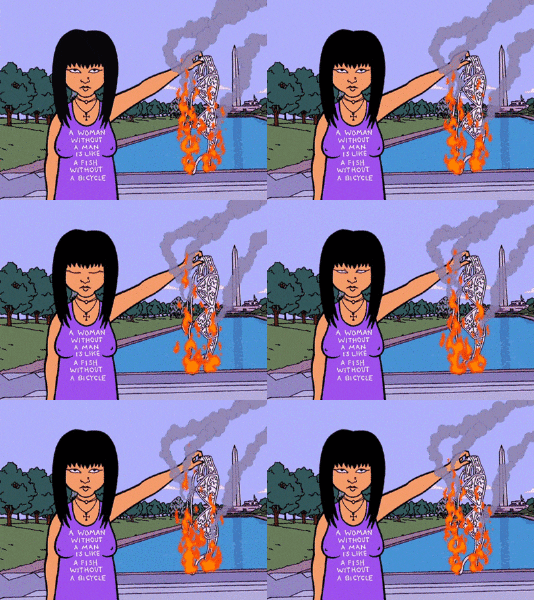
Recently, I’ve been hyperaware of this falseness and lack of diversity in the accounts I followed on Instagram and recently have actively followed a more diverse range of people; feminists, human rights activists and more of the queer community. Some of my favourites are Florence Given, @ellessechar and The Cherry Revolution. By opening up my community I’ve become less interested in being perfect for Instagram, this is why I created a third space where I could post more freely on the topic of feminism while sharing my art. For my digital artefact in BCM114 I wanted to make an Instagram where I can create through my art and poetry injustices and advocate for feminism. A “third space is a space of difference and hybridity”, where one can develop a community to express their identity where they may have trouble elsewhere.
By developing my own third space I have a place to connect with like-minded people about feminist issues that otherwise might annoy or bother people on my personal account (Edirisinge, et al., 2011). Third spaces allow us to challenge and transcend our normative perceptions of our world and allow us to see the authentic and inauthentic versions of ourselves (Pennington, 2018). In my instance by indulging in my third space, through understanding the real and false aspects of my identity that I present online and in real life, I can see alternative ways of understanding and living through my daily experiences (Pennington, 2018). Identity on social media is hard to navigate authentically as we naturally want to be seen in our best light, through exploring more diversity instead of following mainly Instagram models, I’ve widened my community and embraced a fuller more authentic identity on social media.
Reference List
Edirisinge, C., Nakatsu, R., Widodo, J. & Cheok, A. D., 2011. Conceptualizing Third Space in Networked Social Media. 2011 Second International Conference on Culture and Computing, pp. 123-124.
Pennington, R., 2018. Social media as third spaces? Exploring Muslim identity and connection in Tumblr. International Communication Gazette , 80(7), pp. 620-636.
 Hallie Rutter
Leave a comment